
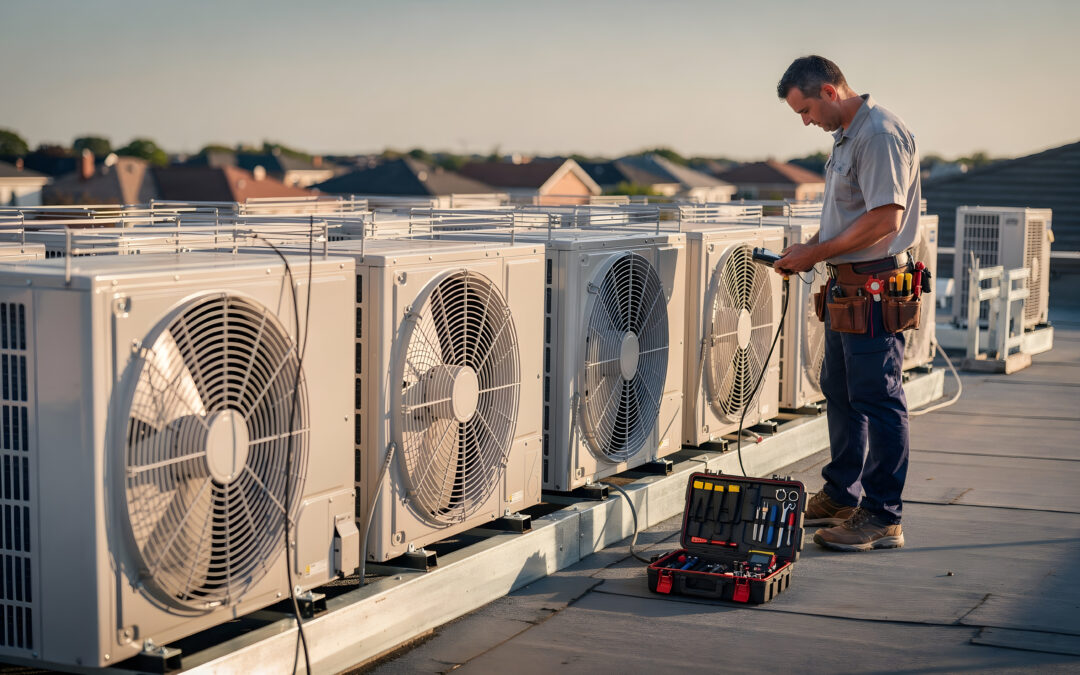
If you own or manage a commercial building in Colorado, you have probably heard that R-410A is being banned. The headlines make it sound like every system on your roof is about to become illegal.
The reality in 2026 is calmer and more useful than that. R-410A is being phased down, not banned. For most Colorado commercial operators the honest answer is that your existing systems are still in compliance. Here is what is actually legal this year, what changed, and what it means for your equipment and your budget.
Is R-410A Banned in 2026? The Short Answer Is No
R-410A is a refrigerant used in a huge share of commercial rooftop units, split systems, and heat pumps. It is being phased down under the federal AIM Act because of its high global warming potential, but phased down and banned are two very different things.
Most of the confusion comes from mixing up three separate activities: manufacturing new equipment, installing new equipment, and servicing the equipment you already own. The rules treat each one differently.
The Three Federal Rules That Actually Matter
1. Manufacturing new R-410A equipment has stopped
As of January 1, 2025, new residential and light commercial air conditioners and heat pumps can no longer be manufactured or imported with a refrigerant above 700 GWP. R-410A sits at roughly 2,088 GWP, so it is over that line.
This is why new light commercial equipment now ships with lower-GWP A2L refrigerants instead. Larger commercial categories phase in on their own schedules: packaged units carry a January 1, 2028 manufacturing cutoff, and variable refrigerant flow (VRF) systems can generally be installed through January 1, 2027 if they were made before January 1, 2026.
2. Installing pre-2025 R-410A equipment is still allowed
There was originally a January 1, 2026 deadline to install any remaining R-410A equipment.
The EPA reversed course and finalized a rule in 2026, effective in late July, that removed that installation deadline for pre-2025 residential and light commercial equipment. In plain terms, R-410A units built before 2025 can still be sold and installed until existing supplies run out. Those units keep their full manufacturer warranty.
3. Servicing your existing R-410A systems is unrestricted
This is the part that matters most for facility managers. There is no rule forcing you to remove or replace a working R-410A system, and there is no restriction on servicing one. You can repair it, fix leaks, replace a compressor, and recharge it with R-410A for as long as the equipment lasts. R-410A remains legal to buy and use as a service refrigerant.
What This Means in Colorado Specifically
Colorado has its own HFC rule on top of the federal ones. Under the Air Quality Control Commission’s Regulation 22, the state restricts high-GWP HFCs in specific end uses: chillers, stationary and commercial refrigeration, foam, and aerosols. If your facility runs chillers or commercial refrigeration, the state limits apply to your new equipment, so it is worth confirming compliance before you buy.
For commercial comfort cooling, meaning rooftop units, split systems, and VRF, Colorado largely follows the federal timeline. Importantly, Colorado has not passed a law forcing the earlier R-410A installation deadline the way New York did, so the federal relaxation applies here. One related state rule to keep on your radar: Colorado now requires newly installed gas furnaces to meet Ultra-Low NOx standards, so if you are replacing heating equipment, that affects your specifications as well.
The Real Story Is Cost, Not Legality
Even though your R-410A systems are legal to run and service, the AIM Act caps how much HFC refrigerant can be produced each year, and that cap keeps tightening. Production dropped to 60 percent of the baseline in 2024 and steps down to 30 percent in 2029.
Less supply means higher prices. By some estimates, R-410A service refrigerant has already climbed 40 to 70 percent since 2022, and it will keep rising. So the pressure on older R-410A systems is financial, not a legal deadline. A major leak or a large recharge simply costs more than it used to, which gradually shifts the repair-versus-replace math over the life of the equipment.
Meet the Replacements: A2L Refrigerants
New commercial systems use a class of refrigerants called A2L, most commonly R-454B (around 466 GWP) and R-32 (around 675 GWP). A2L means mildly flammable, which sounds alarming but describes a refrigerant that is hard to ignite and burns slowly. New equipment is built for it, with leak sensors and updated safety standards. For your facility, the practical takeaway is that new installations have different safety, service, and technician-training requirements, so the contractor you use for a new system should be trained and equipped for A2L.
What Colorado Commercial Operators Should Actually Do
The honest guidance is short and unglamorous:
- Do not panic-replace. A working R-410A system is legal to run and service
- Plan replacements around real end of life and economics, not a myth of a ban
- Budget for rising R-410A service costs on your older systems
- When you replace or build new, spec A2L-ready equipment and an A2L-trained contractor
- If you run chillers or refrigeration, confirm new equipment meets Colorado’s Regulation 22 limits
- Keep clean service and refrigerant records, since documentation requirements are tightening
How Thrivaire Helps Colorado Facilities Navigate the Transition
Staying ahead of refrigerant regulations is part of our job so it does not have to be part of yours. Thrivaire is a Denver commercial HVAC team built on straight answers, not upsells. We will not tell you to tear out a healthy R-410A system, and we will tell you plainly when a replacement makes sense on cost or reliability. Our preventive maintenance plans keep aging systems running efficiently and catch small leaks before they become expensive ones, and when the time is right, we handle A2L-ready system replacements and new construction on your timeline and budget.
Have questions about a specific system or a compliance requirement for your facility? Contact our team or call (303) 935-1944. We are glad to walk your building with you and give you an honest assessment.
Frequently Asked Questions
Is R-410A illegal in Colorado in 2026?
No. Existing R-410A systems are legal to operate and service, and pre-2025 R-410A equipment can still be installed. What changed is that new light commercial equipment is now built with lower-GWP A2L refrigerants instead of R-410A.
Do I have to replace my commercial R-410A system?
No. There is no requirement to replace a working R-410A system. Replacement is an economic and reliability decision, not a legal one, and rising refrigerant costs are usually the deciding factor over time.
Can I still get R-410A to service my system?
Yes. R-410A remains available and legal for servicing existing equipment. Expect prices to keep climbing as federal production caps tighten, especially heading into 2029.
What refrigerant do new commercial systems use?
Most new commercial comfort cooling equipment uses an A2L refrigerant, typically R-454B or R-32. These have a much lower global warming potential than R-410A and require A2L-trained installation and service.